House thermal insulation value
When I saw Mark Sampson, ‘Grand Design’ building his own straw bale house, for me it was the first episode a
natural product was used to build a house. During the years we see that concrete or stone are strong materials but
not the best solution for thermal insulation. Also the use of asbestos or PUR foam will decrease the health rapidly. It
becomes more and more important to insulate a house because of the climate and the use of natural products to
save the earth.
My house has double windows. It is build between two other houses with concrete walls. The walls are cavity walls.
The roof is covered with roof tiles, fiberboard and stone wool. The inside of the roof is also fiberboard. The floor is of
reinforced concrete, covered with natural wood fiber and wood.
Is my house well insulated?
To know that I have to find out how you measure this value. There are 2 things you need to know.
1- The thickness of the material (in meters);
2- The value of the material ( W/m
2
.K ). Also known as λ (lambda)
The formula for thermal resistance is: Rc = thickness in meters / W/m
2
.K
For glass (U) is an other calculation but in the chart I have adjusted.
For building a house the standard Rc:
In 2012 was 2,5.
In 2015 is for:
walls Rc 4,5;
roof Rc 6,0;
floor Rc 3,5.
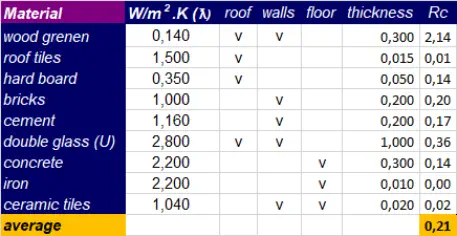
When you look at the chart under ‘Rc’ I calculate that the total average Rc of our house is 0,21. The conclusion is that
it is far beyond the standard. There is a lot to win.
Natural Insulation materials
There are different natural insulation materials.
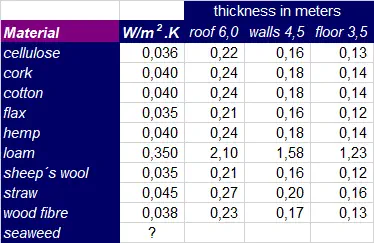
I created a chart with the materials and their insulation value.
There are 3 columns; roof, walls and floor with their Rc’s standard (see previous item).
In the columns are the minimum thicknesses in meters of those materials to fulfill the minimum standards.
In the chart you see that sheep’s wool and flax have the lowest value but of all products except loam are good
insulation products. 25 cm for a roof or 15 cm for a floor is enough to fulfill for the current criteria.
My 1st choice of insulation materials
Walls (min. Rc 4,5)
As I wrote, I saw in ‘Grand Design’ a house with walls of straw. The thickness for walls of straw is about 40 to 50 cm.
In the previous item 20 cm was enough for the current standard. With a thickness of 40 to 50 cm it gives a Rc of 8,9
to 11,1.
The advantages of straw are:
- high insulation
- fire proof
- natural
- cheep
- easy to handle
- good finishing with loam
Roof (min. Rc 6,0)
To built a roof with straw is more difficult to work with. Products like sheep´s wool or hemp is easier to cope with.
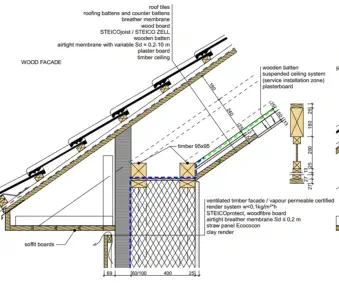
Flax is durable and has no allergic or toxic. In my example I use a construction from an eco building company. The
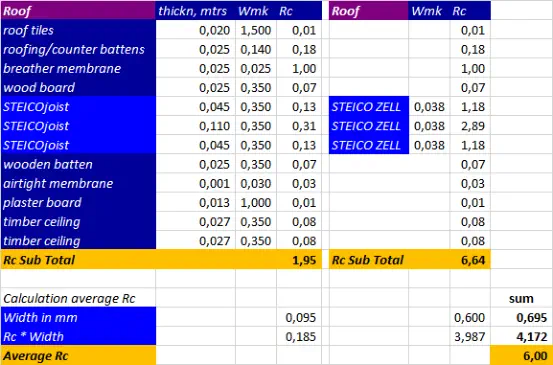
roof has wooden batten to carry the roof but between these battens there is the roof insulation (STEICO ZELL). That’s
why you see 2 Rc calculations, 1,95 and 6,64. I have calculated the average per m
2
. It gives an Rc-average of 6,00.
That is just sufficient for the standard of 2015.
Floor (min. Rc 3,5)
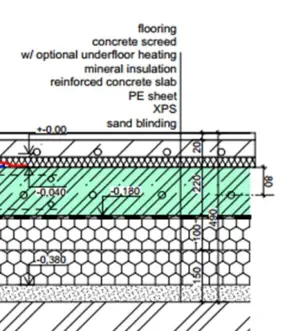
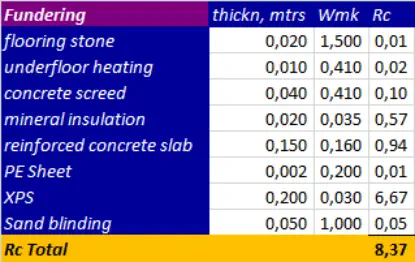
Because I want floor heat, the materials I mentioned by walls and roof are not the first I think of. The floor has to
carry weight when you walk on it. I have an example of a floor construction and the calculation of the Rc. As you can
see is the total Rc 8,37 where the standard is 3,5. And so it is more than enough.
with STEICO ZELL
with STEICOjoist
Rc of our house