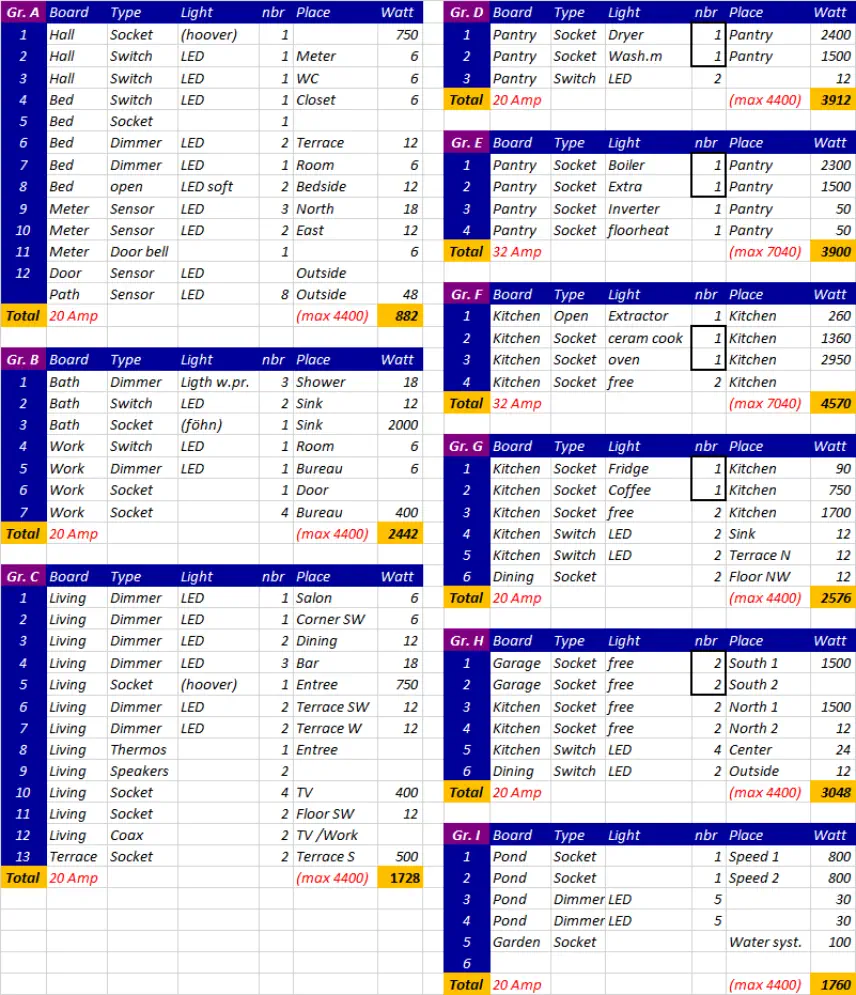
Electrical groups creation
I am not an electrician, so I have to read and to understand how it all works and apply on my electrical needs.
I cached myself thinking that there were parts I encountered it did not crossed my mind before. Such as sensors
(night), speakers and smoke detectors.
Also that different countries have different rules. Ans almost forgot the solar panels with the electrical power storage.
The combination of grid and self supporting electric.
An electrical plan has 6 parts to explain the need and places of the electricity in and, in this case, around the house
- circuit diagram
- pipes diagram
- cable diagram
- installation diagram
- installation drawing
- framework
The power comes from the electricity grid in the house to the meter. From the meter first it is connected to the the
main switch, next there is the ground leak switch. and that is connected to 1 or more fuse switches. Max 4 per one
ground leak switch.
Every fuse switch has a max voltage range. A fuse switch can have e.g. 10 amp, 20 amp or 32 ampere etc.
The electricity grid delivers 220 volt (most European countries). On 10 ampere fuse switch you can get a maximum of
220 x 10 = 2200 Watt. On 20 amp 4400 Watt and on 32 amp 7040 Watt.
Formula P (power) =U (volts) x I (amperes).
A group is all connections of sockets, switches and lamps on one fuse switch.
I have designed all the electric needs in and around the house as far as I know by know.
As you can see there are 9 groups ( from A to I ). The number of fuse switches are, 8 of 20 amps an d 2 of 32 amps.
For each 4 fuse switches you need 1 earth leak switch. So I need 3 earth leak switches.